Tools
What Is a Cash Denomination Calculator?
Learn what a denomination calculator is, how it works, who uses it, and why it matters in India’s cash-heavy economy.
Read More →Free online tool trusted by bank cashiers, accountants, shopkeepers, and students across India. Count ₹500, ₹200, ₹100, ₹50, ₹20, ₹10, ₹5, ₹2, and ₹1 denominations with automatic total calculation, PDF export, and print-ready denomination sheets.
No recent calculations saved yet.
If you have ever stood at a bank counter and watched a cashier count a stack of notes twice because the first tally did not match the deposit slip, you already understand why denomination-wise cash counting matters. The problem is not the arithmetic — multiplying 15 by 500 is simple enough. The problem is doing nine such multiplications in sequence, under time pressure, without transposing a digit, skipping a denomination, or double-counting a note that stuck to the one above it.
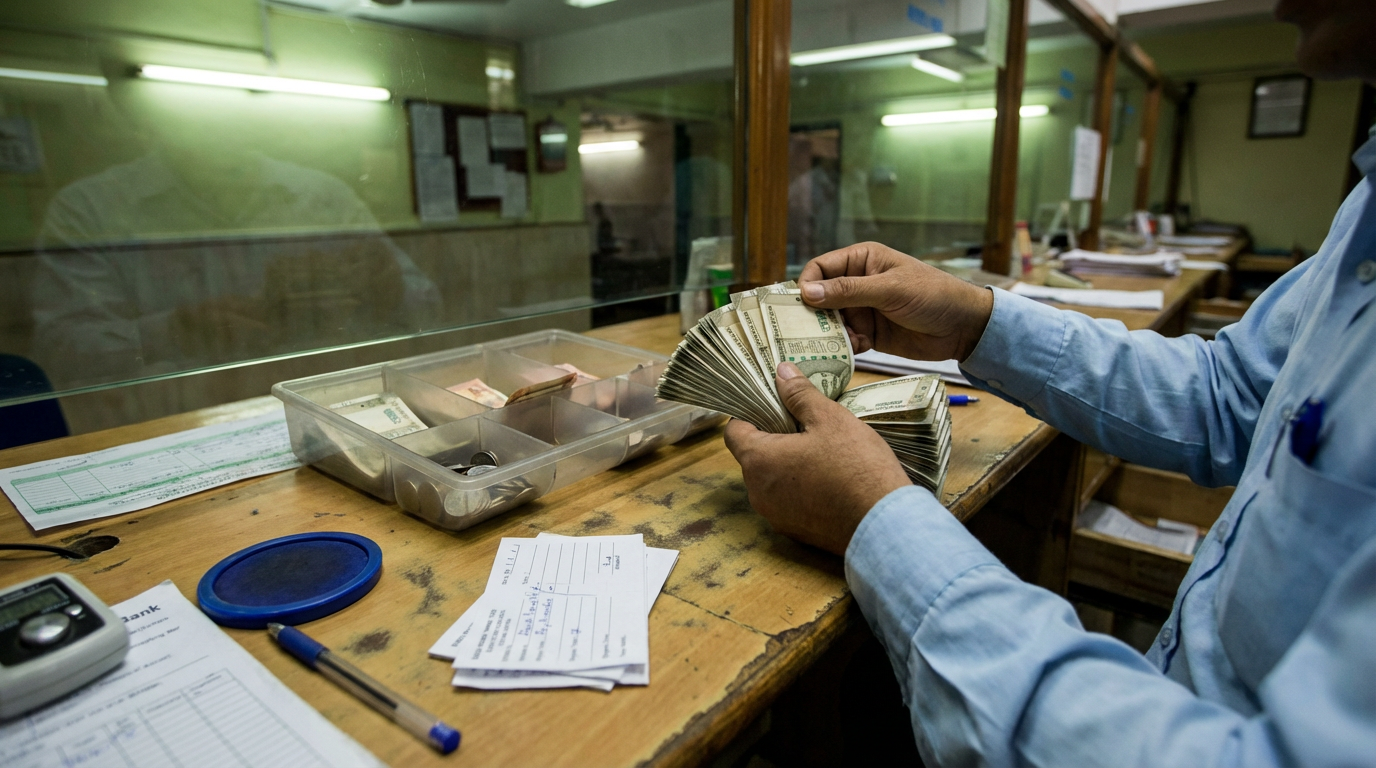
This guide walks you through using our calculator step by step, but more importantly, it explains why each step exists, what real-world mistakes it prevents, and how the tool aligns with the denomination-slip format that Indian banks actually require at the counter. For a deeper tutorial, see our complete step-by-step guide to using the calculator. If you need printable denomination sheets, check our cash denomination sheet format and template guide.
Start by physically sorting your cash into separate piles — one pile per denomination. This is not a shortcut; it is the standard operating procedure described in the RBI’s Master Direction on Currency Distribution and Exchange[1]. Bank branches sort incoming cash into denomination-wise bundles of 100 notes each, and even machine-counted cash is verified against denomination totals. Applying the same discipline at home or at your shop dramatically reduces errors.
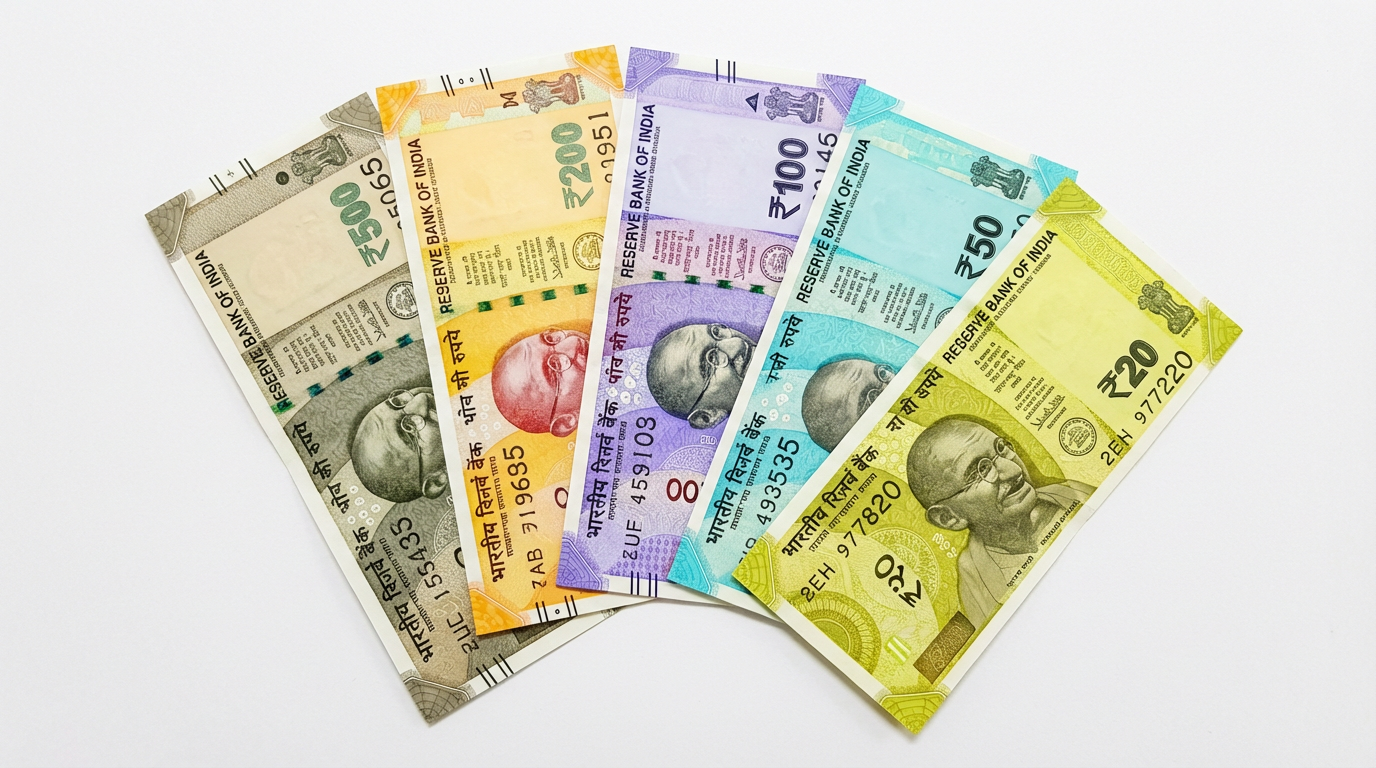
The calculator lists all nine denominations currently in active circulation as recognised by the RBI: ₹500, ₹200, ₹100, ₹50, and ₹20 banknotes; the ₹10 denomination (which circulates as both a Mahatma Gandhi Series banknote and a bimetallic coin); and ₹5, ₹2, and ₹1 coins. Each input field accepts only positive whole numbers — the tool automatically strips out decimals, negative signs, and non-numeric characters — so there is no risk of accidental entry errors.
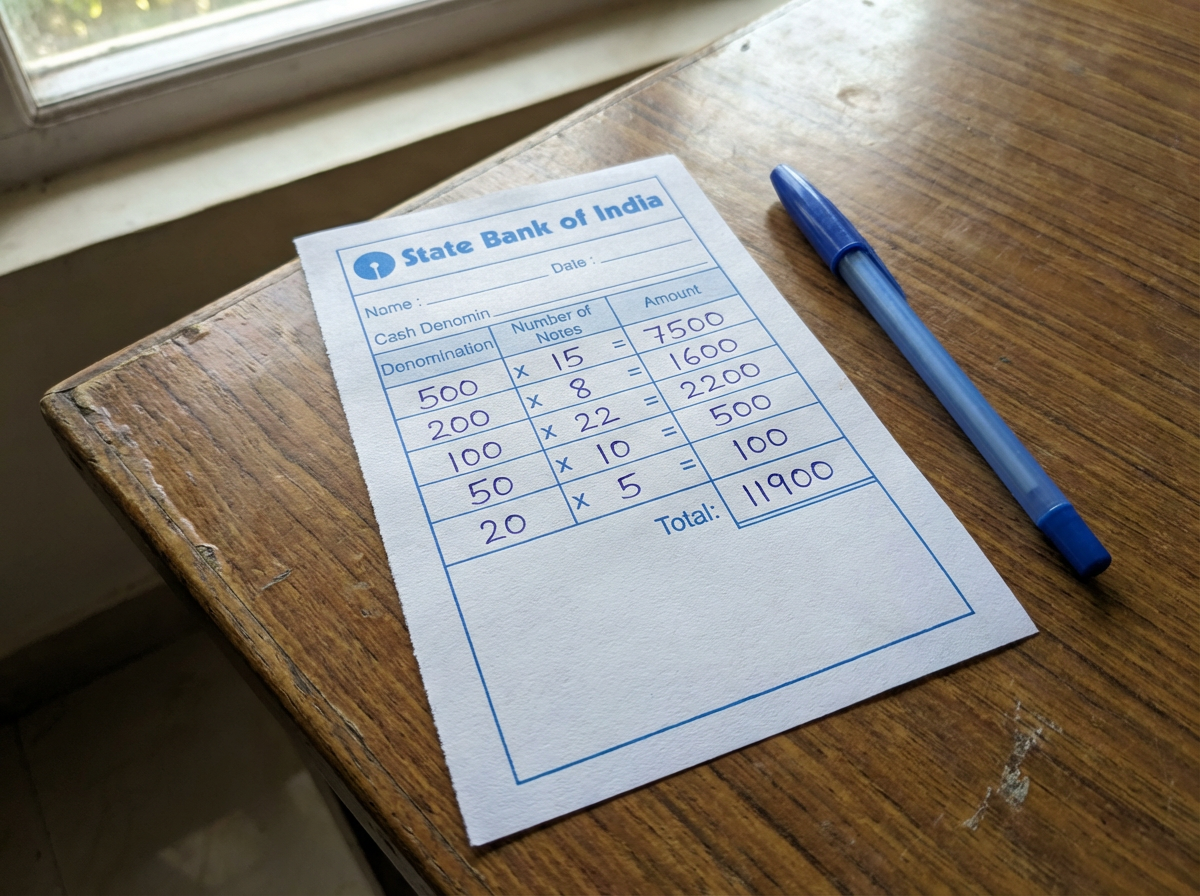
15 in the ₹500 row, 22 in the ₹100 row, 8 in the ₹50 row, and 30 in the ₹10 row. The subtotals update instantly to ₹7,500 + ₹2,200 + ₹400 + ₹300 = grand total of ₹10,400. No button press needed.
When counting notes in bulk, use the “fan-and-count” method: hold a stack of same-denomination notes in your left hand, fan them with your right thumb, and count in groups of five. After every 20 notes, place a finger as a marker. This is the method used by bank tellers across India, and it reduces miscounting by roughly 80% compared to flipping notes one by one. Once you have your per-denomination count, enter it into the calculator rather than attempting the multiplication in your head.
As you type each number, the subtotal for that row appears immediately on the right side of the grid. This real-time feedback exists for a specific reason: it makes large errors visually obvious before they propagate into the grand total. If you accidentally type 150 instead of 15 for ₹500 notes, the subtotal shows ₹75,000 instead of ₹7,500 — a tenfold discrepancy that jumps out when you glance at the column.
In practice, the most common denomination-counting mistakes at Indian retail counters are: (a) confusing ₹200 notes with ₹50 notes because both use blue tones under fluorescent lighting; (b) accidentally including old Mahatma Gandhi Series ₹100 notes (orange-pink) with new series ₹200 notes (bright yellow) in the same pile; and (c) double-counting notes that stick together due to humidity — a daily reality during the monsoon months in coastal and eastern India. Row-by-row subtotal verification catches all three error types before you submit a deposit slip that does not balance.
According to the RBI’s Annual Report 2023–24[2], the volume of banknotes in circulation as of 31 March 2024 was 13,054 crore pieces (130.54 billion notes) with a total value of ₹35.15 lakh crore. The ₹500 denomination alone accounted for 86.5% of the total value in circulation. Even a 0.1% counting error on a daily ₹500-note tally of ₹50,000 translates to ₹50 per day, or ₹18,250 per year — a meaningful loss for a small business.
The same report notes that 21.6 crore counterfeit notes were detected across the banking system in FY2023–24. Denomination-wise counting forces you to examine each note type individually, which also increases your chance of spotting counterfeits.
Below the denomination grid, the calculator displays your Grand Total formatted in the Indian numbering system — that is, using Lakhs (₹1,00,000) and Crores (₹1,00,00,000) rather than the Western Millions format. This is not a cosmetic choice. Every Indian bank deposit slip, cheque leaf, pay-in slip, and cash memo uses the Indian format. Entering ₹123,456 on a deposit slip when the correct Indian format is ₹1,23,456 will confuse the teller and may delay your transaction.
Directly beneath the total, the calculator shows the amount in words — for example, “One Lakh Twenty-Three Thousand Four Hundred Fifty-Six Rupees Only.” This is the exact phrasing required on bank instruments under Section 6 of the Negotiable Instruments Act, 1881[3], which mandates that the amount on a cheque must be stated in both figures and words. Banks will return cheques and reject deposit slips where the words and figures do not match. Having the calculator generate the words for you eliminates this common rejection point.
Many people write “Twelve Lakh” for ₹12,00,000 but then write the figure as ₹1,200,000 (Western format) on the same slip. Banks treat this as a mismatch. Always use ₹12,00,000 in figures when you write “Twelve Lakh” in words. Our calculator displays both in the correct Indian format so you can copy them directly onto your deposit slip or voucher.
Once you are satisfied with your count, the calculator provides four export options, each designed for a specific real-world scenario:
Print (🖨) — Generates a clean denomination sheet formatted exactly like the slips used at bank cash counters: denomination, count, subtotal per row, and the grand total in both figures and words at the bottom. At branches of SBI, PNB, Bank of Baroda, and most other nationalised banks, the cashier will ask you to submit a denomination slip along with your cash. Instead of filling it out by hand at the counter, you can hand over this pre-printed sheet. This reduces your wait time and eliminates the risk of a handwriting-induced transcription error.
Download PDF (📄) — Opens a print-ready view; select “Save as PDF” in your browser’s print dialog. This creates a date-stamped, permanent record of the denomination count that you can attach to accounting entries in Tally, Zoho Books, or any bookkeeping software. Under the Income Tax Act, Section 44AA[4], businesses with turnover exceeding ₹25 lakh (for professionals) or ₹2 crore (for businesses) are required to maintain books of accounts. A saved PDF denomination sheet supports your cash-book entries during an audit.
Copy Summary (📋) — Copies a text summary to your clipboard, ready to paste into WhatsApp, email, Google Sheets, or a Tally narration field. This is the fastest way to share a denomination count with a partner, accountant, or manager without printing anything.
Share (📤) — Uses your device’s native share functionality (Web Share API) on supported mobile browsers, letting you send the calculator link directly via WhatsApp, Telegram, SMS, or email with one tap.
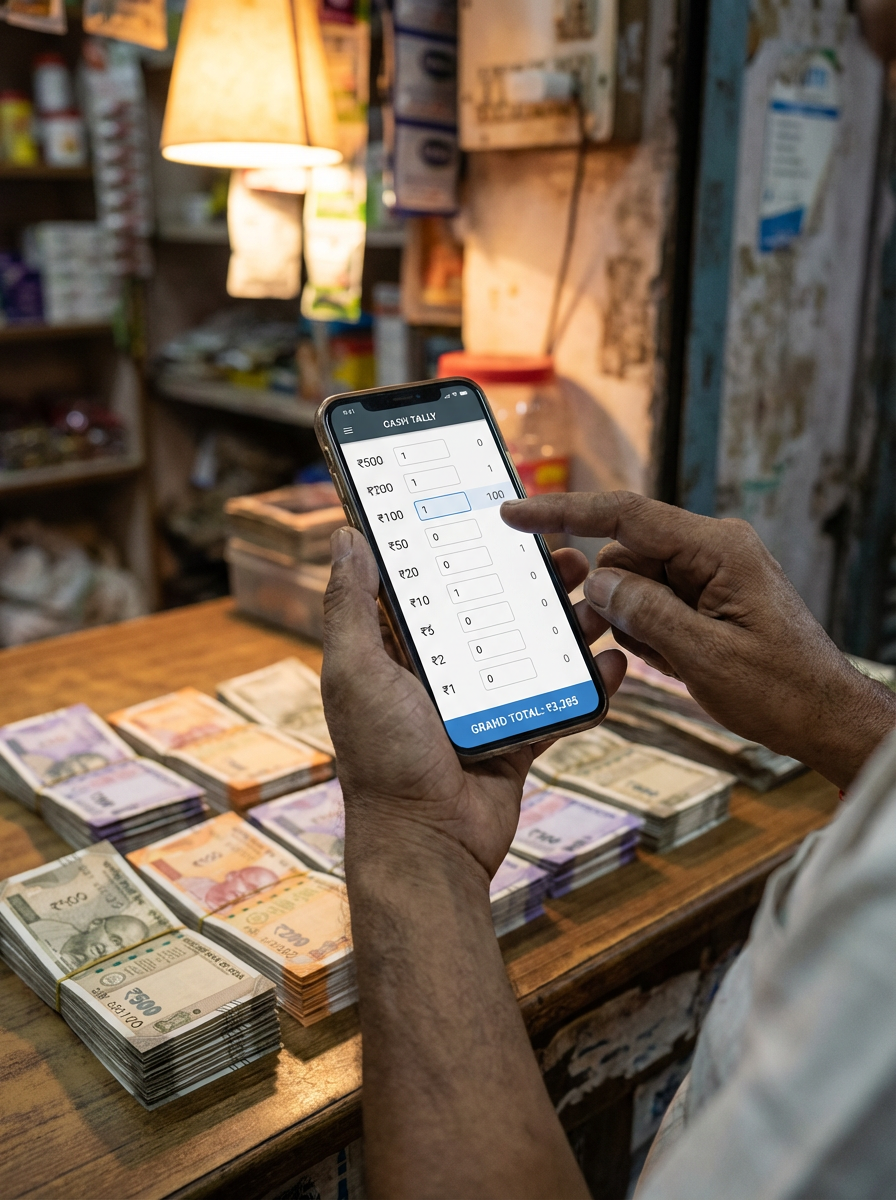
Bank cashiers and tellers — learn how banks use denomination calculators for daily cash tallying. They reconcile their cash drawers at the start and end of every shift. The standard bank procedure requires counting each denomination separately, recording the count on a denomination register, and tallying it against the system-generated cash position report. A senior cashier at a busy urban SBI branch may handle 200–400 cash transactions per day[2]. Using a digital denomination calculator instead of a handheld calculator reduces the shift-end reconciliation from approximately 15–20 minutes of manual arithmetic to under 3 minutes of data entry, freeing time for customer service and reducing overtime.
Retail shopkeepers and kirana store owners — discover why every cashier needs a denomination calculator. They handle mixed-denomination cash throughout the day. At closing, they must count the register, separate the next day’s opening float (typically ₹2,000–₹5,000 in small denominations for making change), and calculate the day’s net collection. The RBI’s 2023 “Payments Vision 2025” document[5] acknowledged that cash still accounts for a significant share of retail transactions in India, particularly in Tier-2 and Tier-3 cities. For these businesses, a denomination calculator that runs on a basic smartphone — without requiring an app download or internet after initial load — is more practical than any desktop accounting software.
Accountants and bookkeepers who manage petty cash imprest funds must perform periodic physical verification. Under Indian Accounting Standard (Ind AS) 7 and the ICAI’s Guidance Note on Audit of Cash and Bank Balances, the auditor is required to verify physical cash at the close of the accounting period and document the denomination-wise count[6]. Our printable denomination sheet serves exactly this documentation purpose — it is timestamped, shows the individual denomination breakdowns, and presents the total in words, which auditors require.
Event organisers and NGOs handling cash collections at ticket counters, donation drives, or vendor payment desks benefit from the copy-to-clipboard and share features. When multiple people collect cash at different counters during an event, each person can use the calculator on their phone, copy the summary, and WhatsApp it to the finance coordinator. This creates an immediate, denomination-wise audit trail without waiting until the event ends.
Students and teachers studying Indian currency, arithmetic, or financial literacy will find the tool a practical learning aid. The Indian numbering system (Lakhs and Crores) is unique to the subcontinent and is not covered in international textbooks. Seeing how ₹9,99,999 becomes “Nine Lakh Ninety-Nine Thousand Nine Hundred Ninety-Nine Rupees” — in real time as you type — reinforces a concept that many students initially find confusing.
Anyone depositing cash at a bank branch needs a denomination count. Under the RBI’s Master Direction — Know Your Customer (KYC) Direction, 2016 (updated 2024)[7], cash deposits exceeding ₹50,000 in a single transaction require PAN or Form 60. For deposits exceeding ₹10 lakh in a financial year in a savings account (or ₹50 lakh in a current account), banks must file a Cash Transaction Report (CTR) with the Financial Intelligence Unit. Having an accurate, pre-prepared denomination slip not only speeds up your transaction but also creates a personal record that may be useful during tax assessment if the deposit is questioned.
“I run a general store near Mansarovar in Jaipur — Sharma Kirana & General Store. We have been open since 2014 and most of our customers still pay in cash. On a normal weekday I handle around ₹35,000–₹45,000 in cash sales, but during Diwali week last October it crossed ₹1,20,000 per day because of dry-fruit and gift-hamper orders.
My routine used to be: after pulling down the shutter at 10 PM, I would sit with a calculator and a notebook and count everything denomination by denomination. It would take me 20–25 minutes on a regular day, and during Diwali week I was sitting until almost 11 PM because the notes were all mixed up — ₹500s stuffed between ₹20s, coins thrown into the same drawer as notes.
Omprakash is a family friend and he told me about Cash Denomination Calculator. The first night I tried it — 18 October 2025 — I sorted the cash into piles like he said, then entered the count on my phone: 42 notes of ₹500, 18 of ₹200, 65 of ₹100, 28 of ₹50, 15 of ₹20, 40 coins of ₹10, and some ₹5 and ₹1 coins. The total came to ₹1,18,550 and matched my UPI+cash day-book within ₹30 (one ₹20 note and a ₹10 coin had fallen behind the counter). The whole count took 4 minutes.
What I really like is the Print button. Every Monday I deposit the week’s cash at Punjab National Bank, Mansarovar branch. Earlier the cashier would make me fill the denomination slip by hand — my handwriting is not great and twice they asked me to rewrite it. Now I print the sheet from Cash Denomination Calculator, walk in, hand it over with the cash, and I am done in 5 minutes instead of 15. My wife uses it too for the household cash she keeps for groceries and school fees.”
“I am a practising CA based in Varanasi — I run a small firm with two articleship trainees and we handle the books for about 45 clients, mostly small businesses and traders in the Godowlia and Sigra areas. Every quarter-end, we do physical cash verification for clients who maintain petty cash imprest funds. Under the ICAI Guidance Note[6], the auditor has to document denomination-wise cash on hand at the date of verification.
Before Cash Denomination Calculator, my process was painful. I would go to the client’s office, sit with their cashier, count every note and coin into piles, write it all down on a sheet of paper, multiply each on my phone’s calculator, add up the subtotals, then type the whole thing into an Excel sheet back at the office for the working paper file. For one client — a saree trader near Vishwanath Gali who keeps ₹2–3 lakh in the drawer at any time — this process took 35 to 40 minutes.
I started using Cash Denomination Calculator in December 2025 during the Q3 closing. On 31 December, I went to the same saree trader’s shop for cash verification. The count was: 84 notes of ₹500, 12 of ₹200, 38 of ₹100, 25 of ₹50, 42 of ₹20, 60 coins of ₹10, 15 of ₹5, and a handful of ₹2 and ₹1. Cash Denomination Calculator showed ₹2,53,220 — I cross-verified the ₹500 pile twice because it was the biggest, and it matched. Total time from sorting to final total: 6 minutes. Then I pressed Print, and that sheet went straight into the audit file as the denomination certificate. No retyping into Excel.
The part that really sold me was the amount-in-words line. On two occasions in previous years, I had written the total in words wrong on the cash verification certificate — once writing “Two Lakh Fifty Thousand” when the figure was actually ₹2,53,000. The partner caught it during review, but it was embarrassing. Cash Denomination Calculator generates the words automatically, so that mistake simply cannot happen anymore. I have recommended it to three other CAs in our local ICAI chapter.”
Human error in cash counting is not a matter of carelessness — it is a predictable consequence of how our brains process repetitive numerical tasks. Cognitive research on counting accuracy shows that error rates increase sharply after the first 50–60 items in a sequence, a phenomenon called vigilance decrement. For a shopkeeper counting 200 notes at the end of a tiring 12-hour day, the final quarter of the count is statistically the most error-prone.
The specific failure modes in Indian currency counting include:
| Error Type | Cause | How This Calculator Prevents It |
|---|---|---|
| Denomination confusion | ₹200 (yellow) and ₹50 (fluorescent blue) look similar under warm lighting; old & new series ₹100 notes differ in colour | Forces you to sort by denomination first, then count each pile separately |
| Stuck notes | New, crisp notes from ATMs stick together, especially in humid conditions | Subtotal verification reveals unexpected totals that prompt a recount |
| Multiplication errors | Multiplying 37 × 200 in your head while simultaneously remembering the previous subtotal | All multiplication is instant and automatic; you only enter the count |
| Carry-forward mistakes | Adding nine subtotals on paper and carrying the wrong digit | Grand total is computed from individual subtotals with zero rounding error |
| Figures-to-words mismatch | Writing “Two Lakh” but entering ₹20,000 (missing a zero) | Words are generated directly from the computed total — they always match |
The RBI’s own infrastructure reflects the magnitude of this problem. According to its Annual Report[2], the RBI operated 19 issue offices and over 4,000 currency chests across the country in FY2023–24 and processed lakhs of crore in notes through high-speed sorting machines that count, authenticate, and sort notes at rates exceeding 30 notes per second. These machines exist precisely because manual counting at institutional scale is unacceptably error-prone. Our calculator brings a fraction of that automation to anyone with a smartphone — for free.
India’s currency, the Indian Rupee (₹), is issued by the Reserve Bank of India under the authority of the Reserve Bank of India Act, 1934 (Section 22). Coins are minted by the Government of India under the Coinage Act, 2011, and issued into circulation through the RBI. As of February 2026, the banknotes in active circulation are ₹500, ₹200, ₹100, ₹50, ₹20, and ₹10 — all belonging to the Mahatma Gandhi (New) Series introduced between 2016 and 2019.
The ₹2000 denomination, introduced on 8 November 2016 during the demonetisation of old ₹500 and ₹1000 notes, was withdrawn from active circulation on 19 May 2023 via RBI circular RBI/2023-24/32[8]. By 30 September 2023, 93% of the ₹2000 notes in circulation had been returned. While they technically remain legal tender, no bank dispenses them, and this calculator therefore excludes ₹2000 from its denomination list to reflect the notes you will actually encounter in daily transactions.
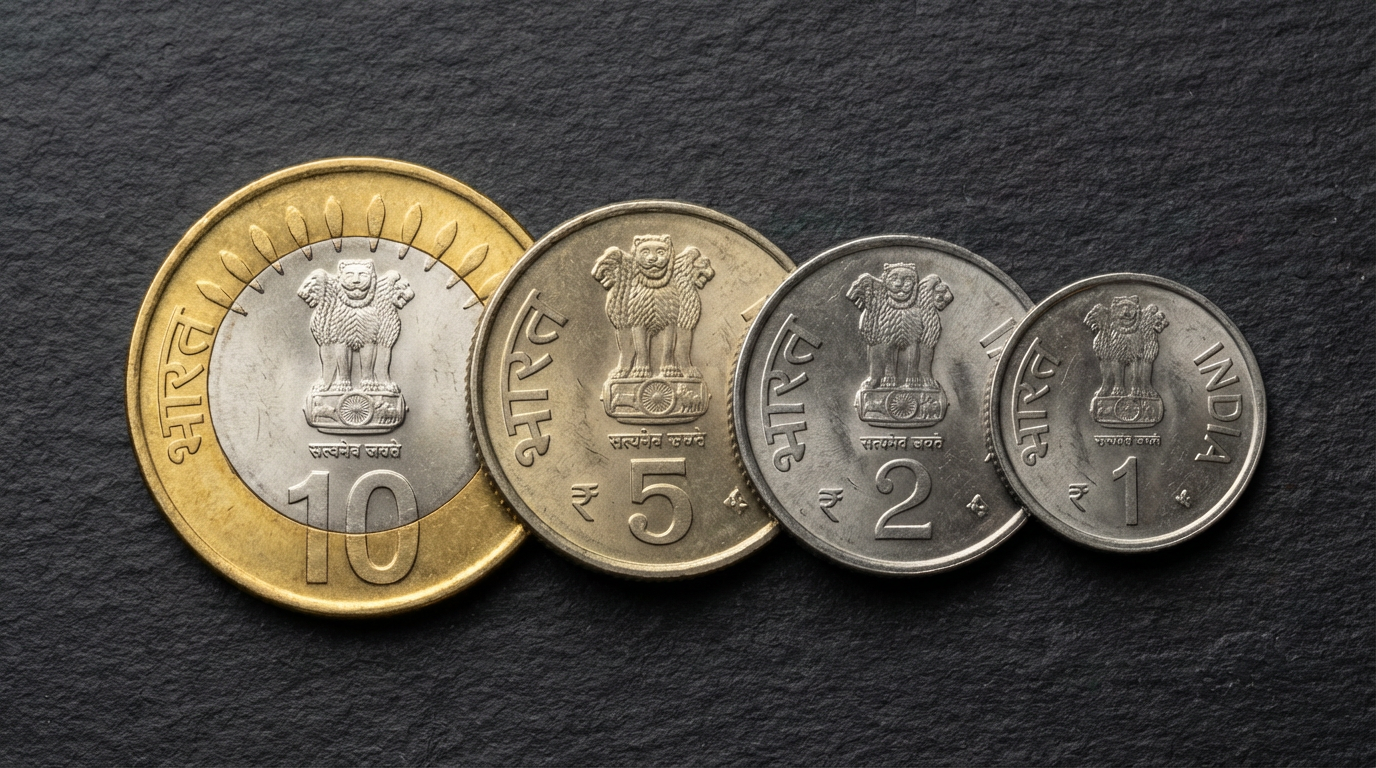
Coins in current circulation — ₹10, ₹5, ₹2, and ₹1 — are minted at the four Government of India Mints in Mumbai (●), Kolkata (no mint mark), Hyderabad (★), and Noida (◦). The mint mark is a small symbol below the year on the coin’s obverse. All coins feature the Lion Capital of Ashoka and display the denomination in both English and Hindi (Devanagari script), as mandated by the Coinage Act.
All nine current denominations recognised by the Reserve Bank of India, at a glance.
Learn More About Indian Currency Denominations → How to Count Mixed Currency Notes →
Learn what a denomination calculator is, how it works, who uses it, and why it matters in India’s cash-heavy economy.
Read More →Complete guide to preparing denomination slips for deposits at SBI, HDFC, ICICI, and other Indian banks.
Read More →Discover how Indian bank branches use denomination calculators for vault management, ATM replenishment, and daily reconciliation.
Read More →Download free denomination sheet templates in PDF and Excel. Learn the correct format for filling bank deposit slips.
Read More →Compare the best free online cash denomination calculator tools by features, privacy, mobile support, and export options.
Read More →Proven techniques to count mixed Indian currency notes without errors — sorting, counting, recording, and cross-verifying.
Read More →Cash Denomination Calculator exists for one reason: to make denomination-wise cash counting faster, more accurate, and completely free for everyone in India who handles cash daily. Our tool is built and maintained by Supraja (content & development) and reviewed by Omprakash, a senior banker with 12+ years of cash operations experience at nationalised banks. Every factual claim on this site is sourced from official RBI publications, Indian legislation, or ICAI guidance notes — and we link to the original source so you can verify it yourself.
Our editorial process: Articles and tool descriptions are drafted with AI assistance by our editorial team, then fact-checked against primary sources (RBI.org.in, legislative databases, ICAI publications), and reviewed by Omprakash for procedural accuracy before publication. We include a “Last updated” date and source citations on every content page. If you find an error, please let us know and we will correct it within 48 hours.