How Many ₹500 Notes Are in ₹1 Lakh? A Practical Cash Breakdown
Ask a search engine how many ₹500 notes are in ₹1 lakh and you get a number. Ask a bank teller who has counted a few hundred lakhs across a counter and you get a story: about packets that come up one note short, customers who arrive without a PAN card, shopkeepers who deposit ₹1 lakh that is somehow never all in ₹500s, and the small physical reality that two hundred notes are heavier than most people expect. This article is written from the second point of view. The arithmetic takes one line; the rest is what you actually need to know when ₹1 lakh in cash is sitting in front of you.
Why 200 is the beginning, not the end
Until May 2023, the honest answer to this question was different for many people: ₹1 lakh was often 50 notes of ₹2,000. When the Reserve Bank of India withdrew the ₹2,000 denomination from circulation [1], the ₹500 note became the highest-value banknote in daily use, and every large cash sum in the country quietly quadrupled in note count. A wedding advance that used to fit in an envelope now fills a small pouch; a shop's weekly takings that used to be a single packet are now two or three; and the probability of a miscount — which rises with the number of pieces handled — went up with it.
That is why “200” deserves more than a one-line answer. The number of notes determines how long counting takes, how much the stack weighs, how banks package it, how a counting machine batches it, and how easily a single missing note hides in the pile. Those practical consequences are the real subject of this guide.
What ₹1 lakh in ₹500 notes physically looks like
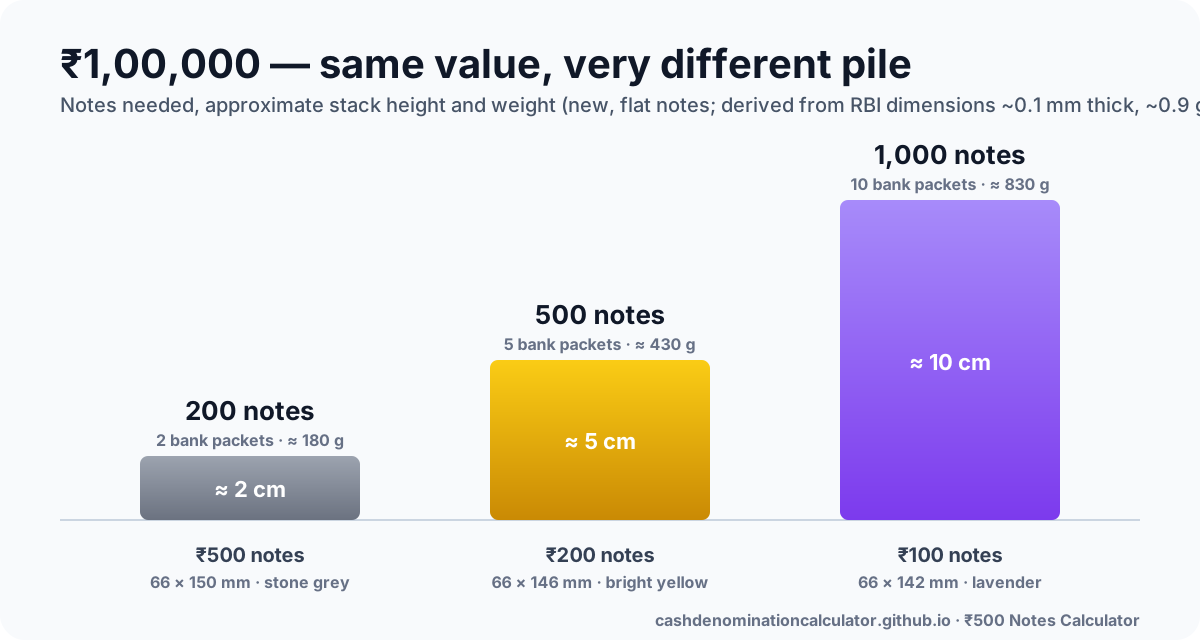
The RBI publishes the dimensions of every current banknote. The Mahatma Gandhi (New) Series ₹500 note measures 66 mm × 150 mm and is printed on cotton-based banknote paper [2]. The RBI does not publish an official weight or thickness, but banknote paper worldwide runs close to 0.1 mm (100 microns) and a note of this size weighs roughly a gram. From those two figures you can derive what 200 notes actually are:
| Property | ₹1 lakh in ₹500 notes | Everyday comparison |
|---|---|---|
| Number of notes | 200 | Two bank packets |
| Stack height (new, flat notes) | ≈ 2 cm | Spine of a thick paperback |
| Stack height (circulated notes) | ≈ 2.5–3.5 cm | Air trapped between soft, creased notes adds bulk |
| Weight | ≈ 180–200 g | Lighter than most smartphones |
| Footprint | 66 × 150 mm | Fits a standard long envelope; too long for most wallets to lie flat |
| Counting time by hand (practised) | 2–3 minutes incl. recount | Roughly 100 notes per minute, counted twice |
| Counting time by machine | ≈ 15 seconds | Desktop counters run 800–1,200 notes/min |
Two details here matter more than they seem. First, the height difference between new and used notes is why a “packet that looks right” can still be wrong — experienced tellers never judge a packet by its thickness. Second, 200 notes is close to the sweet spot where hand counting stops being sensible: at ₹1 lakh you can still count by hand reliably, but at ₹5 lakh (1,000 notes) a counting machine stops being a luxury.
How banks pack ₹1 lakh: packets, straps and what the band tells you
Indian banks follow RBI's Clean Note Policy, which since 2001 has prohibited stapling of note packets [3]. Instead, notes are organised in a strict hierarchy that is worth knowing because it tells you, at a glance, how much is in front of you:
- Packet (100 notes) — held by a paper band. For ₹500 notes one packet is ₹50,000. The band is usually stamped with the branch name, date and the initials of the teller who counted it. ₹1 lakh = 2 packets.
- Bundle or “brick” (10 packets = 1,000 notes) — packets stacked and strapped with plastic or paper straps. One ₹500 brick is ₹5 lakh. ₹1 lakh is one-fifth of a brick.
- Currency-chest standards — RBI's own packaging for bank-to-bank movement, which the ordinary customer never sees.
Here is the practical point: when a teller hands you ₹1 lakh as two banded packets, those bands are a form of guarantee. A teller counted them, initialled them, and the bank will stand behind the count if you raise the issue before leaving the counter. Once you walk away, the burden of proof flips. That is why every bank hall has a sign asking you to count your cash before leaving; it is not a courtesy, it is where liability changes hands. If you receive a packet with a band that is torn, re-taped, or carries no stamp, ask for it to be recounted in front of you.
The 199-note trap: why ₹1 lakh so often counts short by one
Of all the counting errors seen at bank counters and shop tills, one pattern dominates: a sum that should be a round 200 comes up as 199 (or, less often, 201). It is rarely theft. The mechanics are almost always one of these:
- Twin notes. Freshly printed ₹500 notes have a slight static cling and near-identical edges. Two notes pass through the fingers as one. This is why counting machines run new-note bundles at a lower speed setting.
- The folded corner. A note with a dog-eared corner sits at an angle and gets skipped when the pile is riffled from the corner.
- The band shuffle. Removing a paper band roughly can slide the bottom note out of the stack and under the counter edge.
- Mid-count interruption. A phone call at note 140; the counter resumes at 150. Over a day of counting, this is the single largest source of discrepancies in retail.
The defence is procedural, not arithmetic. Count in tens, place each ten at a slight angle to the previous ten (a “stair”), and never treat 100 as a single mental unit until you have seen ten stairs. Count each 100-note packet separately rather than the full 200 in one pass — a mistake then only costs you a 100-note recount, not a 200-note one. Our guide to counting mixed notes covers the same technique when denominations are jumbled together.
₹1 lakh in other denominations — and why it is almost never “pure”
In theory ₹1 lakh is 200 notes of ₹500. In practice, the ₹1 lakh that a shopkeeper deposits at the end of a week looks nothing like that. Retail cash arrives as change-heavy, mixed-denomination takings, and the deposit slip reflects it. The table below shows both the textbook figures and a realistic composition:
| Denomination | Notes for ₹1 lakh (pure) | Bank packets | Typical share in a retail ₹1 lakh deposit* |
|---|---|---|---|
| ₹500 | 200 | 2 | ₹60,000–₹75,000 (120–150 notes) |
| ₹200 | 500 | 5 | ₹10,000–₹15,000 (50–75 notes) |
| ₹100 | 1,000 | 10 | ₹10,000–₹15,000 (100–150 notes) |
| ₹50 | 2,000 | 20 | ₹2,000–₹5,000 |
| ₹20 | 5,000 | 50 | ₹500–₹2,000 |
| ₹10 | 10,000 | 100 | ₹500–₹1,000 |
*Indicative range for a general store or pharmacy; a petrol pump skews further toward ₹500, a tea stall further toward ₹10 and ₹20.
This is the difference between a theoretical and a practical breakdown. A pure-₹500 lakh takes three minutes to verify; a realistic retail lakh takes fifteen, needs a denomination sheet, and is exactly where a denomination calculator earns its keep — the multiplication of 137 × 500 + 62 × 200 + 118 × 100 + … is where tired-evening arithmetic errors creep in.
The thresholds that ₹1 lakh in cash quietly crosses
₹1 lakh is an interesting amount legally: large enough to trigger identification rules, small enough to remain fully permissible. Three rules matter most for an ordinary individual or small business.
PAN for cash deposits above ₹50,000 in a day
Under Rule 114B of the Income-tax Rules, a cash deposit exceeding ₹50,000 with a bank in a single day requires the depositor to quote their PAN, or submit Form 60 if they do not have one [4]. A ₹1 lakh deposit is twice that threshold. If your PAN is already seeded to the account the teller will simply verify it; if not, you will be asked for the card or Form 60 at the counter. Splitting the deposit across two days to stay under ₹50,000 is not advisable — banks aggregate and report such patterns.
Section 269ST: the ₹2 lakh cash-receipt ceiling
Section 269ST of the Income-tax Act prohibits any person from receiving ₹2 lakh or more in cash from a single person in a day, in respect of a single transaction, or in respect of transactions relating to one event [5]. A single ₹1 lakh cash payment — a wedding hall advance, a used-car token, a contractor's milestone — is therefore permitted. But two ₹1 lakh payments for the same event or transaction are not, even on different days. The penalty under Section 271DA equals the amount received, and it falls on the recipient.
Reporting, not prohibition
Banks file Cash Transaction Reports for aggregate cash deposits of ₹10 lakh or more in a financial year in a savings account. A one-off ₹1 lakh deposit does not approach that, but a shop depositing ₹1 lakh weekly will cross it in ten weeks — which is entirely normal for a business account and simply means the deposits should be reflected in the books. See our guide to RBI cash deposit rules for the full picture.
Four real scenarios, and what “200 notes” means in each
1. Depositing a week's shop takings
You have roughly ₹1 lakh in a cash bag. It is not 200 notes; see the retail table above. Sort by denomination the night before, count each pile into tens, fill the denomination slip, and carry PAN. The ₹500 pile will be your largest value but not your largest count — budget your time for the ₹100s.
2. Withdrawing ₹1 lakh for a family event
This is the one case where you really will hold 200 notes of ₹500. Expect two banded packets. Count both at the counter — stair method, tens — before signing the voucher. If you are paying several vendors, ask the teller to break one packet into ₹200 and ₹100 notes now; getting change later is harder than people assume. An ATM cannot do this for you: typical per-transaction limits of ₹10,000–₹25,000 and daily caps of ₹20,000–₹1,00,000 mean a branch visit is the practical route.
3. Paying ₹1 lakh as a token or advance
Permitted under Section 269ST, but protect yourself: insist on a signed receipt stating the amount in figures and words, the date, and the purpose. Photograph the two packets' bands if they are still bank-banded; a stamped band is useful evidence of count. Do not pay a second ₹1 lakh in cash for the same deal — move to a bank transfer.
4. Paying ten workers ₹10,000 each
Here ₹1 lakh in pure ₹500s is exactly right: 20 notes per person, ten envelopes. Count 20 notes into each envelope, then verify by weight-of-habit — ten identical envelopes should feel identical. Most payroll discrepancies in small units come from one envelope receiving 19 or 21 notes, so a second person checking each stack of 20 is worth the five minutes.
A 3-minute checklist for verifying ₹1 lakh in ₹500 notes
- Square the stack. Tap the long edge on a flat surface until all edges align.
- Separate the two packets. Treat each 100 as its own job.
- Fan and check for twins. Riffle the top corner; watch for notes that lift together.
- Count in tens, stair each ten. Ten stairs = 100. Do not proceed until you see ten.
- Scan for a mismatched note. A ₹200 or old-series ₹500 slipped in changes the total without changing the count.
- Glance at security features. Tilt a few notes to see the colour-shifting security thread (green to blue) and the ₹500 numeral. Our counterfeit detection guide has the full list.
- Record it. 200 × 500 = 1,00,000 on the slip or in the calculator. Writing it down is what makes the count auditable later.
One final note on the number itself. India writes ₹1 lakh as 1,00,000, not 100,000 — the comma falls after the first three digits and then after every two. If you are filling a deposit slip or a cheque, use the Indian grouping; a teller will read “100,000” correctly, but a cheque that mixes systems invites a query. Our Indian numbering system guide explains the lakh–crore convention in full.
Frequently Asked Questions
₹1,00,000 ÷ ₹500 = 200 notes. In Indian bank terms that is exactly two packets of 100 notes each, worth ₹50,000 per packet.
A ₹500 note measures 66 × 150 mm and banknote paper is roughly 0.1 mm thick, so 200 flat new notes stack to about 2 cm and weigh roughly 180–200 g — about the spine of a thick paperback and lighter than a smartphone. Used, soft notes stack noticeably taller.
Yes. Under Income-tax Rule 114B, a cash deposit exceeding ₹50,000 in a single day requires you to quote your PAN (or submit Form 60). ₹1 lakh crosses that threshold, so carry your PAN card or ensure it is already linked to the account.
Generally yes. Section 269ST bars receiving ₹2 lakh or more in cash from one person in a day or for one transaction or event, so a single ₹1 lakh cash receipt is permitted. Keep a written receipt and make sure the source of cash is explainable.
The commonest reasons are a folded corner that hides one note, two new notes sticking together and being counted as one, or a note shifted when the band was removed. Count each 100-note packet separately in groups of ten and recount any packet that does not land on exactly 100.
Not in one go. Most Indian bank ATMs cap a single withdrawal at ₹10,000–₹25,000 and daily limits typically range from ₹20,000 to ₹1 lakh depending on the card. Withdrawing ₹1 lakh usually means a branch visit, where you will be handed two 100-note packets of ₹500.
Sources:
[1] RBI Press Release, 19 May 2023 — “₹2000 Denomination Banknotes – Withdrawal from Circulation; Will continue as Legal Tender” — rbi.org.in
[2] RBI Paisa Bolta Hai — ₹500 banknote, Mahatma Gandhi (New) Series: features and dimensions — rbi.org.in
[3] RBI Clean Note Policy / Master Circular on Facility for Exchange of Notes and Coins (no stapling of note packets) — rbi.org.in
[4] Income-tax Rules, 1962 — Rule 114B (transactions requiring PAN) — incometaxindia.gov.in
[5] Income-tax Act, 1961 — Section 269ST and Section 271DA — incometaxindia.gov.in
Stack height and weight figures are editorial estimates derived from published note dimensions and typical banknote-paper specifications; they are not official RBI data. Legal thresholds are stated as of the publication date and may change; verify with the current Act and Rules before relying on them.